.svg)

.png)

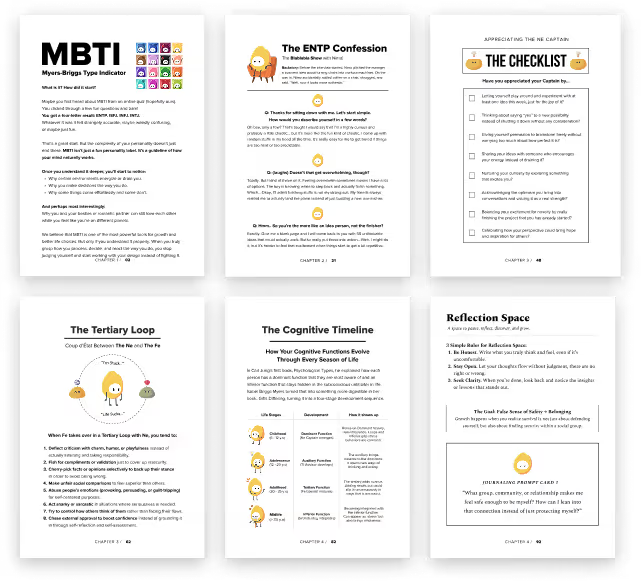
The MBTI, short for Myers-Briggs Type Indicator, is a personality framework designed to help people understand their natural ways of processing information and making decisions. The name 'Myers-Briggs' comes from a mother-daughter pair: Katharine Cook Briggs and Isabel Briggs Myers. During the mid-20th century, they developed this theory to make insights about personality more practical and accessible for everyday people.
Their work was inspired by the ideas of Swiss psychiatrist Carl Gustav Jung, particularly his Theory of Psychological Types. Jung proposed that people naturally prefer certain ways of perceiving the world and making decisions. He first introduced this theory in his 1921 book "Psychological Types", where he explored how individuals rely on different psychological processes (later known as cognitive functions) to guide their daily actions.
However, as MBTI has grown in popularity, misconceptions and misuses have also spread everywhere. Some people interpret personality types too rigidly (viewing them in black-and-white terms), while others reduce them to oversimplified stereotypes.